


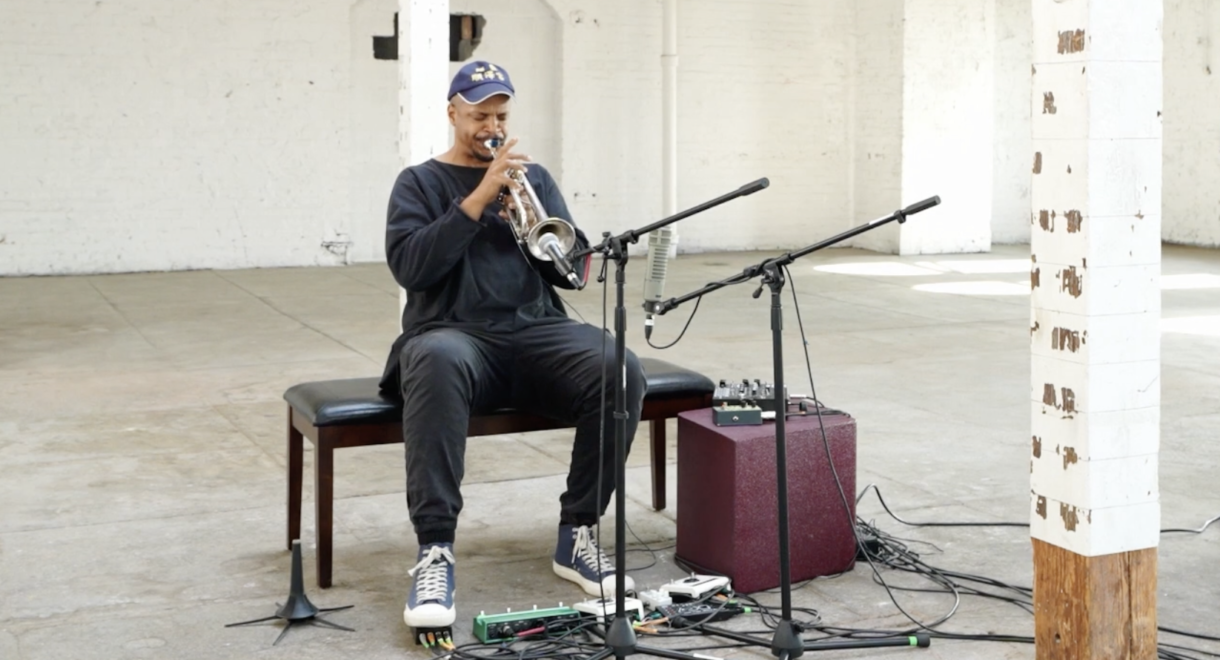
EM Records Brings Jeff Bruner’s West Coast Minimalism Back Into Focus

Written By: 
Randall Roberts
Tags: 
Share:
  •  
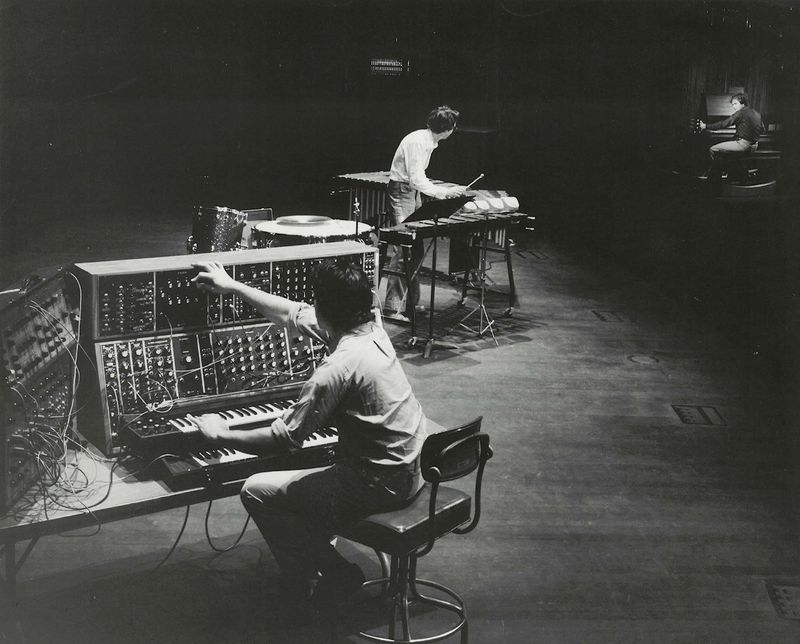
Black-and-white photo of three musicians performing onstage: one seated at a large modular synthesizer in the foreground, another standing at a vibraphone or percussion setup in the center, and a third at a piano in the background. The arrangement emphasizes the scale of the analog equipment and the spatial relationship between performers in a dim, rehearsal-like environment.

A four-decade span of work, from tape-loop experiments to spare acoustic pieces, reveals a composer shaped by Santa Barbara’s post-serialist fringe and the quiet influence of Daniel Lentz and Harold Budd, now gathered in Four Corners.

Jeff Bruner didn’t arrive at composition through a single lineage so much as a series of converging paths. Raised in Santa Barbara in a household where 78s, classical records and inherited folk instruments coexisted, he moved early between worlds: garage-band bass player, student of music theory, theater composer, experimenter with tape and pattern. By the time he entered UC Santa Barbara in the early 1970s, the academy was still gripped by serialism, but Bruner found his way toward a different current, one shaped by the example of his mentor Daniel Lentz and kindred figures like Harold Budd, where beauty, repetition and atmosphere carried a quiet but decisive force.

That sensibility threads through Four Corners, a new compilation on EM Records that gathers work spanning more than four decades, from the late 1970s to the present. The collection moves easily across Bruner’s range: the interlocking, tape-driven patterns of “Magic Mbira,” with echoes of Terry Riley’s cyclical logic; the warped, dub-adjacent “Reggae Foes,” born from a low-budget science-fiction score; the stark, tactile reworking of an American folk melody in “Cold Rain and Snow”; and the spare piano meditation “Remembrance in a Pale Room,” written in tribute to Lentz. What emerges is less a retrospective than a set of coordinates, four points tracing a practice grounded in repetition, timbre and a persistent desire to take music out of the concert hall and into lived space.

Bruner’s career has rarely followed a straight line. After early work in experimental composition and performance in California, he moved through New York’s post-punk and theater scenes, then into the more pragmatic world of commercial music, where he won an Emmy and a Clio before stepping away from composition for nearly a decade. His return, sparked by a modest home recording setup and a renewed interest in acoustic instruments, carries the same exploratory spirit as his earliest work.

The conversation that follows, which has been edited for length and clarity, traces that arc in detail, from handmade instruments and tape-loop illusions to film scoring drama, lost recordings and a late-career reemergence.


Pre-order Jeff Bruner’s Four Corners through our webshop

What was the music like in your house when you were a kid? 

I hadn’t really considered it before, but music in my household was pretty eclectic. We had a piano. My mother liked classical music, but she also had a great collection of 78s from the ’30s and ’40s. My great-grandfather played banjo and fiddle and had been a square dance caller, and although I didn’t have much interaction with him, I did end up with his banjo and fiddle.

Is that the banjo you use on one of the pieces on Four Corners?

No, I don’t use his actual banjo. I got two from him. One he built from scratch. He was an Indiana farmer with his own shop and could make anything. I had a hatchet he forged for me, all kinds of strange things. That banjo isn’t really playable anymore. The other one I had, the playable one, got stolen when I was in college. So my background is very eclectic, growing up with swing, blues, bluegrass and classical. I was playing in bands with my friends when I was 10 or 12, playing rock ‘n roll.

What instruments?

Bass. I tell everybody I played bass because I was the worst guitar player in the band, which I was, and the bass parts were one note, so it felt manageable. I enjoyed that role. Instruments, or personalities, attract certain instruments, and the bass player is the peacemaker between the singers, guitarists and drummers.So I fell into that role. But I was also taken by the music in Bonnie and Clyde, Lester Flatt and Earl Scruggs, “Foggy Mountain Breakdown.” That was a great tune in that film. I pursued that somewhat, but was more focused on rock and roll of the ’60s and ’70s.

In high school I got more interested in classical music and piano, started taking lessons and got into music theory. So when I went to college after graduating in ’72, I majored in music theory and composition, not really knowing much about composition, but it seemed like a compelling direction. I’d written some piano pieces and wanted to learn more. That brought me into a whole other world of music.

What university? Where did you go to school?

UC Santa Barbara. Dan Lentz had just left, I think, by the time I started. He was still in Santa Barbara, and I came to know of him through other composer friends at UC Santa Barbara, a guy named Garry Eister, who I believe is still writing, and Marc Ream, who was also doing interesting work then. I recently found a guitar quartet Garry did, kind of in memory of Dan Lentz, and it’s really quite good. It’s on YouTube.

Going into the university in the early ’70s, the accepted musical language was serialism —  12-tone row. But it had really reached its logical dead end by the late ’60st , but still what you needed to work within if you wanted to function in the academic system. My favorite Arnold Schoenberg quote is, “The best thing about my system is that it doesn’t quite work.” A lot of people missed that. They treated it as total control. From there I started looking for more engaging music.
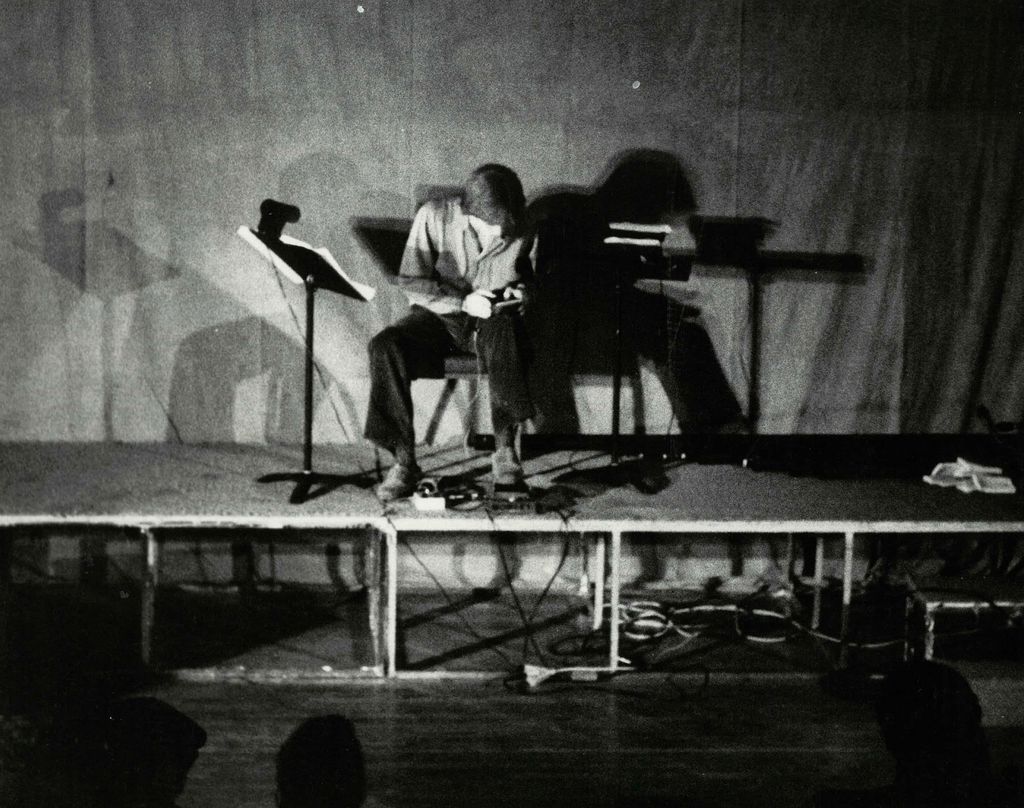
Black-and-white photo of a solo performer seated on a small stage, leaning forward over a compact setup of electronic devices and cables. A music stand sits to the left, while stark lighting casts oversized shadows of the performer and equipment across a plain backdrop, giving the scene a quiet, experimental feel.

At first, composers like Luciano Berio and George Crumb drew me in. They were working outside strict serialism and making music that actually engaged listeners. Serial music can be very academic, but their work had immediacy. That led me toward people like Dan Lentz and Harold Budd, who were doing something radical for the time: writing beautiful music. In that environment, that was almost subversive.

That became a big influence, the idea that music could be beautiful without relying on conventional tonality, that it could establish its own internal logic. Working with Dan Lentz, I picked up one of his techniques, a cyclic structure that feels like digital delay but is actually an illusion built from pre-recorded layers. He takes phrases like “you can’t see the forest for the trees,” breaks them into phonemes, and layers them cycle by cycle until the full phrases emerge. At the same time, performers are drinking wine, changing the pitch of the glasses as the level drops. By the end everything falls into place. It sounds like real-time delay, but it’s constructed in advance. That’s the basis for what I used in “Majic Vira.”

I was going to ask you about that.

I would pre-record a track, then perform it live, and when the tape comes in it sounds like playback, though it’s part of a designed illusion.

You performed that at the Summer Solstice Festival?

Yes. That was my favorite performance. I also did it at what we called the Last Concert of the ’70s, New Year’s Eve 1979, but the Summer Solstice Festival in Santa Barbara stands out.


Can you set the scene? What was the festival like?

When I got out of college, I wanted to take composed music out of the concert hall. Concert halls felt restrictive. I wanted spaces where people could relax and engage with the music more freely. I had worked with the Summer Solstice organizers, including Michael Gonzales and Jenny Sullivan, through theater projects. I brought them the idea, played the piece for them, and they responded immediately.

At the end of the parade, everyone gathered in the courthouse gardens. There were probably around 10,000 people. A friend of mine, Ron Garrison, did these helium balloon releases. In that environment I started the piece. I was struck by how people responded. They began moving and dancing spontaneously. It really set the tone for the event.

I’ve been listening to that piece in my listening room, and it sounds remarkable at proper volume. It’s mesmerizing.

I appreciate that. The piece started with a thumb piano my mother gave me. It was handmade, not polished, very percussive. I attached a pickup and realized how good it sounded amplified. I built patterns, one thumb alternating two notes, the other three, so the relationship keeps shifting. Then I layered those patterns to build the piece.

That was recorded on a TEAC four-track?

Yes.

When did you record it?

Late ’70s, probably ’78 or ’79. It wasn’t for a specific purpose. I just wanted to make it. The TEAC four-track was a turning point. Before that, layering required studio access. Suddenly you could do it at home. The limitations pushed you toward creative solutions, bouncing tracks, pre-mixing. The ’70s were an especially creative period in recording because of those constraints.

How did you end up scoring the film Foes, and what was that experience like?

How much dirt do you want?

I want it all.

All right. Foes was produced by Coats-Alexander, three guys. Two Coats brothers, Richard and John, and Robert Alexander. Richard was my classmate in high school. John developed the concept and special effects. Alexander was, frankly, a bit of a shyster, selling the project to investors. I had just graduated and had some money from a lawsuit after my father died in a plane crash. I had about $10,000 that I told Richard I’d invest if I could score the film. He agreed, but he didn’t really have that authority.

They had another composer in mind, John LaSalle, who created an instrument called the Cosmic Beam. It made striking sounds, but didn’t work for scenes with human interaction. They gave me a chance to score a six-minute sequence for potential investors. I tried writing it, didn’t like anything and threw it out. At midnight, with nothing finished, I just improvised. When I synced that to picture, it lined up perfectly, even hitting small moments in the film. That got me the job. I later orchestrated it for an 18-piece ensemble and recorded it in Santa Barbara.

The film didn’t sell as expected. It was eventually bought by a British company and recut. The music was chopped up, sped up in places to create tension. It was not handled well.

And the reggae track, “Reggae Foes”?

That came from the producers wanting a radio-friendly single. The score didn’t really have anything that fit, so they brought in a producer who suggested reggae. We took the end theme and reworked it into a reggae arrangement with four bass tracks, no drum kit and a lot of percussion, including steel drums. We recorded the same track twice. The second version is more intense, more like a dub, with elements entering across the stereo field, almost like layers being dropped in. The lyrics came from the producers, “leave us alone,” “they only cover it up,” reflecting the film’s darker take on alien contact.
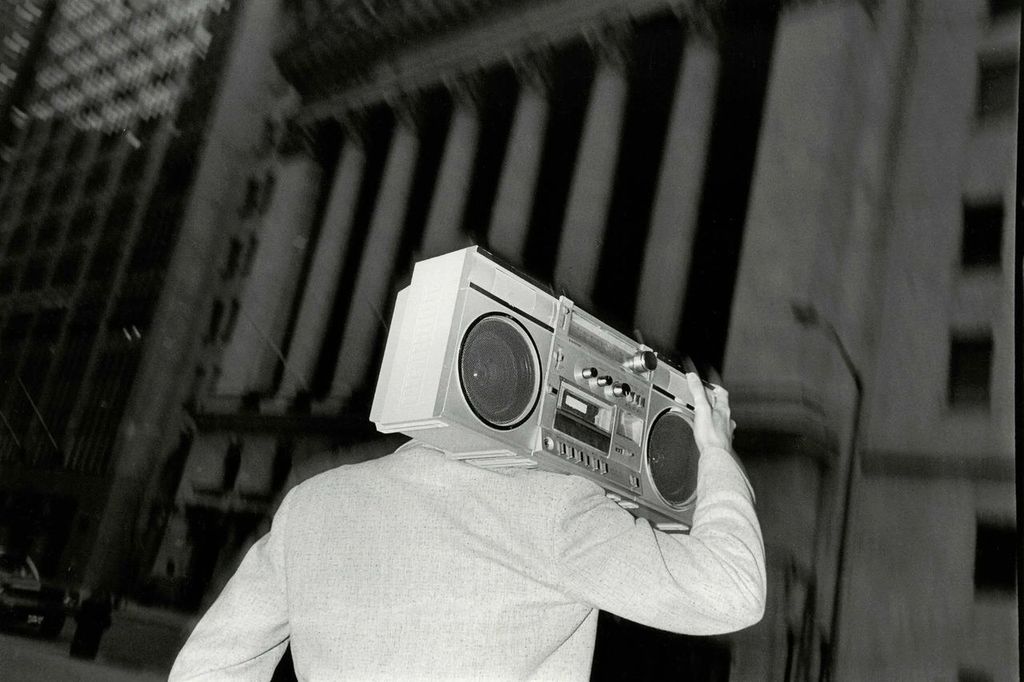
Black-and-white photo of a person seen from behind walking through a city at night, carrying a large vintage boombox on their shoulder. Tall buildings rise on either side, their vertical lines slightly blurred, while the figure’s light-colored jacket and the angular shape of the stereo stand out against the darker urban backdrop.

Let’s talk about this new collection, Four Corners. How did this project come together?

It started when Spencer Doran (Visible Cloaks) reached out to me asking if I was the Jeff Bruner behind “Reggae Foes.” I didn’t think anyone even knew about it. I sent him a copy, and he connected it to Koki at EM Records in Japan. Koki became interested in reissuing it and asked if I had more material. We gathered pieces from different periods, “Mbira,” the banjo piece, a piano piece from the ’90s. It’s a varied collection, which is why it’s called Four Corners, different influences intersecting.

How much recorded material do you have?

Probably less than I’ve lost. There are pieces I can’t find anymore, including a percussion work recorded on quarter-inch tape that’s disappeared over time.

You also did commercial music for a time?

I was in Santa Barbara until about 1981, when I decided it was time to move to the big city, so I picked up and moved to New York. There I fell into a number of things. I played in a kind of post-punk band, playing places like CBGB, but I also continued with composition and more conceptual work, collaborating with dancers and performance artists and doing music for theater. I started working with a Shakespeare company, writing music for their productions.

That eventually branched into what were then called industrials, corporate communications projects that were these large multimedia affairs commissioning original scores. One of the more fun ones involved a company pioneering digital effects for pharmaceutical presentations at medical conferences, showing molecules floating through plasma and docking. I built out an electronic music studio in New York to do that kind of work. It paid well, but it was inconsistent, and once I had kids, I started looking for something more stable.

That led me to a staff position in Cincinnati, writing music for advertising, with a salary plus commission. I was able to do some interesting work in that world, and through it I won an Emmy and a Clio, which are basically the Oscars of advertising. But ultimately, advertising is soul-sucking. It isn’t real music, it’s imitation.

In the ’90s, for example, when the Seattle sound was big, someone had the idea to score a Puffy bicycles spot with a grunge version of Flight of the Bumblebee. A kid is running through the forest, a bee chasing him, then it crashes into his helmet. It was fun to make. I worked with a classical violinist playing electric violin, ran it through distortion, layered in guitars, bass and drums, and it hit hard. But I’m not a grunge artist. I’m imitating one, pulling elements together and synthesizing them into something that isn’t quite real.

That was the pattern. One day I’d be writing a big band score, the next a dramatic underscore, the next something like that Bumblebee piece. The variety was interesting, but it also reinforced the same problem. None of it felt like real music.

After that period, I stopped making music for about 10 years. Part of that was a lawsuit with my employer that dragged on for about a year and left a bad taste. I ended up working in sales, eventually in the mortgage industry. When everything collapsed in 2008, I was still employed, but I had a brief stretch of a couple weeks off between roles.

I found myself wondering if I could even still play. So I started recording again, just with what I had around the house. In commercial work I had been deep into MIDI and sequencing, controlling everything down to the smallest detail. This time I wanted to see if I could make something meaningful with acoustic instruments. I had a banjo, my daughter had just started playing upright bass, and we had a piano. I began putting things together with those, along with whatever odd instruments I could find. I used some drum loops, but it was much more organic. It felt like a reawakening.

Since then I’ve stayed active, doing more playing than composing. Now that I’ve retired from my day job and moved to New Mexico, I’m looking at getting back into composing in a more serious way and seeing where it leads.

Hopefully Four Corners is the first of many projects to come.

I hope so. It was great working with EM. They’ve been very supportive.

Preorder Four Corners through our shop now; retailers interested in stocking the release can contact us directly [email protected] for distribution details.

Related Articles

Sort By
12th Isle
1asia
2 Tone
2020
2022
2023
2024
33rpm
45rpm
4AD
5 Selects
5 Seletcs
7"
99 Records
A Colourful Storm
A&M
Abbey Lincoln
Aboriginal
Abstract
Abyssinians
Ace Tone
Acid
Acid Archives
Acid Folk
Acid House
Acid Jazz
Acid Mt. Fuji
Acid Punk
Acid rock
Acid Techno
Acoustic
Acoustic Energy
Adrian Sherwood
ADS
Advent
Africa
African
Afro
Afro House
Afro-Cuban
Afrobeat
Afrofuturism
Alan Braufman
Alan Ginsberg
Alan Greenberg
Alan Thicke
Albert Ayler
Album Cover
Alejandro Cohen
Alex Patterson
Algerian
Alice Coltrane
All Genre
Altec
Alternative
Alternative Rock
Altın Gün
Alvin Lucier
AM Radio
Amantes del Futuro
Amaro Freitas
Amazon Music
Ambient
Ambient House
Ambient Jazz
ambient techno
American Primitive
Americana
Amoeba Music
Amplifier
Analog
Anatolian
Anatolian Rock
Andrew Hale
Andrew Weatherall
Andy Votel
Andy Warhol
Anenon
Animal
Animation
Anna Butterss
Annette Peacock
Ansonia
Anton Fier
Antonio Zepeda
AOR
Aphex Twin
Aquarium Drunkard
Arabic
Archie Shepp
Archival
Ariwa
Armenia
Arooj Aftab
Art
Art & Design
Art Dudley
Art Film
Art Pop
Art Rock
Artform Radio
Arthur
Arthur Magazine
Arthur Russell
Article
Arvo Part
Ash Ra Temple
Asian Underground
ATO Records
Audio Note
Audiogon
Audiophile
Audiovisual
Austin Peralta
Australia
Autechre
AV Moves
avant
Avant-Garde
Avant-pop
Avant-Rock
Avent-Garde
Baba Stiltz
Balearic
Bali
Ballad
Balmat
Bananafish
Barbarelle
Bargain Bin
Bark Psychosis
Baroque
Baroque Pop
Basic Channel
Basquiat
Bass
Bauhaus
Bayou Funk
Bazantar
BBC
BBC Archive
BBC Radiophonic
Be With Records
Beat Scene
Beatles
Beats
Beats in Space
Beaumont Hannant
Bebop
Because Music
Beirut
Belgium
Ben UFO
Bennie Maupin
Berlin-school
Best of 2020
Beverly Glenn​-​Copeland
Bhutan Stamps
Big Band
Big Ears
Bill Laswell
Bitchin Bajas
Black Ark Studios
Black Jazz
Blake Mills
Blaxsploitation
Blood & Fire
Blue Note
Blues
Blues Rock
Bob Marley
Bob Weir
Bola Sete
Bolero
Bollywood
Boogie
Book
books
Bookshelf Speakers
Boom Bap
Boredoms
Bossa
Bossa Nova
Boymerang
Brainfeeder
Brazil
Brazilian Folk
Breakbeat
Breaks
Breezy
Brendan Eder
Brian Eno
Broadcast
Bruce Haack
Bruce Weber
Bruton Music
Bryan Ling
Buddhism
Budget Audiophiler
Bureau B
Burundi
C-Pop
Cabaret
Cabaret Voltaire
Cafe Del Mar
Calypso
Cambridge Audio
CAN
Candombe
Cannanes
Canterbury
Cantopop
Cape Jazz
Cape Verde
Caribbean
Carl Craig
Carla Bley
Carlos Nino
Carlos Niño
Cartridges
Casio
Cassette
Cate Kennan
Cats
CD
Celia Hollander
Celluloid
Celtic
Chamber Jazz
Chamber Music
Chamber Pop
Chan Marshall
Channel One Studios
Chanson
Charles Bals
Charles Lloyd
Charles Mingus
Chee Shimizu
Chemical Imbalance
Chet Baker
Chicago
Chicha
Chillout
China
Chinese
Chiptune
Choral
Chris & Cosey
Christmas
City Pop
Classic Album Sundays
Classical
Classics
Clicks & Cuts
Clothing
Club
Cocteau Twins
Coctueau Twins
Coffee
Cold Wave
Coldwave
Colombia
Colorfield
Comedy
Cometa
Commercial
Community
Compass
Compass Point
Compilation
Conatala
Concept Album
Condesa Electronics
Conlon Nancarrow
Conny Plank
Contemporary Jazz
Cool Jazz
Cornelius
cos/mes
Cosmic
Cosmic Disco
Cosmic Folk
cosmic jazz
cosmic synths of africa
Country
Country Pop
Country-Rock
Cover
Cover Art
Covers
Crash Richard
Criterion Collection
Crusaders
Cuba
Cult Classic
Cumbia
Curtis Mayfield
D'Angelo
DAC
Dacne
Daedalus
Daft Punk
Dallas
Dan Greene
Dance
Dance Mania
Dance Music
Dancehall
Daniel Aged
Daniel Lentz
Dark
Dark Ambient
Dark Entries
Darkwood Dub
Darling
David Behrman
David Bowie
David Byrne
David Lynch
David Murray
David Sylvian
David Toop
Davida
Dedicated listening session
Deep Dive
Deep House
Deep Listen
Deep Listening
Delia Derbyshire
Dembow
Demo
Dennis Bovell
Denon
Detroit
Devotional
DFA
Diabate
Diasporic Disco
Dick Verdult
Diggin in the Mags
Digi-Reggae
Disco
Discodelic
Discogs
Discos Fuentes
Distribution
DIY
DIY / Amateur
DJ
DJ Funk
DJ Kicks
DJ Shadow
Documentary
Dogs
Don Buchla
Don Cherry
Donald Byrd
Donations
Doo Wop
Doom Metal
Dou Wei
Downtempo
Dowtempo
Dr. John
Dream House
Dream Pop
Dreamy
Drone
Drum & Bass
Drum Break
Drum Machine
Drum n Bass
Drum&bass
Drummers
Drums
Dual
Dub
Dub Poetry
Dub Techno
dublab
Dublin
Dubstep
Dubwise
Dumb Type
Durutti Column
Düsseldorf School
Dust and Grooves
Dustin Wong
Dynaco
Eames
Earl King
Early Electronic
East Africa
East African
Easy Listening
Eberhard Weber
Eblen Macari
EBM
ECM
ecoustic
ecoustics
Edits
Edward George
Egberto Gismonti
Eiko Ishibashi
El Marchante
Electric Lady
Electric Satie
Electro
Electronic
Electronic Jazz
Electronica
Elegant Pop
Elliot Bergman
Elvin Jones
EM Records
Emahoy Tsegué-Maryam
Enossified
Environmental Music
Enya
EOY
Eric Dolphy
Erik Satie
ESG
Esoteric
ESP Institute
Essential Listen
Essential Listening
Essential Listenning
Estonia
Estradayin
Eternity’s Pillar
Ethereal
Ethiopian Jazz
Ethnic
Ethno-Jazz
Event
Events
Excavated Shellac
Exit to Vintage Street
Exotica
Experimental
Fabiano Do Nascimiento
Factory Records
faitiche
Fania
Faye Wong
Feel Good All Over
Fela Kuti
Fennesz
Festival
Field recording
Film
Films
Fingertracks
Fingetracks
Fires
Fishing with John
Fishmans
Flamenco
Fleetwood Sound Company
Floating
Floating Points
Folk
Folk Funk
Folk-Rock
Folkways
Fonts
Footwork
Force Inc.
Four Tet
Fourth World
France
Frank Rosaly
Frankie Knuckles
Free Improvisation
Free Jaz
Free Jazz
Friends of ISC
Frippertronics
Frozen Section Radio
Fundraiser
Funk
Fusion
G-Funk
G.S. Schray
Gaita
Gal Costa
Gamelan
Garage Rock
Garrard
Gems from the Dollar Bin
Geographic North
George Duke
George Martin
George Oban
German techno
Ghana
Ghetto House
Ghostly International
Gifts
Gilberto Gil
Giorgio Moroder
Glam Rock
Glitch
Global
Goaty Tapes
Gogo
Golden Palominos
Goldenring
Gondwana Records
Good Neighbor
Gospel
Grace Jones
Grado
Graham Sutton
Graphic Novel
Grateful Dead
Green-House
Group Sounds
Growing Bin
Guaracha
Guide
Guitar
Gwo Ka
Gwoka
Gypsy
Habibi Funk
Habitat Ensemble
Haçienda Club
halloween
Hard Bop
Hard Rock
Hard Wax
Harman Kardon
Harold Budd
Harp
Harry Nilsson
Haruomi Hosono
Hawaii
headphones
Heavy Metal
Henry Kawahara
Henry Lewy
Henry Threadgill
Herbie Hancock
hi-fi
hi-NRG
Hidden Gem
High Fidelity
Highland Park Sleep Collective
Highlife
Hip Hop
Hip-Hop
Hiroaki Sugawara
Hiroshi Yoshimura
Hiroshima
history
Holger Czukay
Holiday
Hollywood
Holy Grail
Homage Brewing
Home Listening
Home Theater
Hong Kong
House
House Rules
Human Head
Hypnotic
Iasos
Ibelisse Guardia Ferragutti
Ibiza
Ichiko Aoba
IDM
Illbient
Illustration
IMA Robot
Improvisation
Impulse!
In Conversation
In Stock
India
Indian
Indian Classical
Indian Raga
Indie
Indie Dance
Indie Pop
Indie Rock
Indigenous music
Industrial
Ingmar Bergman
Ingram Marshall
Installation
instock
Instrumental
International
International Anthem
Internet Archive
Interview
Iran
Irish folk
ISC
ISC Classic
ISC Collection
isc guide
ISC NYC
ISC Record Store
ISC Selects
Island Records
Isolation
Italian Film Music
Italo Disco
Italo House
Italy
JACCC
Jackie McLean
Jacob Miller
Jah Shaka
Jam Band
Jamaica
James Baldwin
Jan Jelinek
Jangle Pop
Japan
Japananese
Japanese
Jasmin Williams
Jazz
jazz funk
Jazz is Dead
jazz kissa
Jazz-funk
Jazz-rock
JBL
JD Twitch
Jeff Mills
Jeff Parker
Jefre Cantu-Ledesma
Jessica Pratt
Jim O'Rourke
Jimmy Cliff
Joanna
Jockey Slut
Joe Claussell
John Cage
John Coltrane
John Fahey
John Martyn
John Peel
John T. Gast
John Zorn
Jon Hassell
Jonathan Ward
Joni Mitchell
Judee Sill
Judy Mowatt
Juke
Julius Eastman
Jungle
K-pop
K. Leimer
K7
Kaleidoscope Kyoto
Kankyo Ongaku
Kankyo Records
Kansas City
KCRW
KEF
Keiji Haino
Keith Haring
Keith Jarrett
Kelan Phil Cohran
Kelela
Khotin
Kid-Friendly
Kikagaku Moyo
Kim Yaffa
King Tubby
Kitty Records
Klaus Schulze
KLF
KLH
Klipsch
Kofi
Kompakt
Kora
Kosmiche
Kosmische
KPM
Kraftwerk
Kranky
Krautrock
Kruatrock
Kruder & Dorfmeister
Kuduro
kwaito
Kwame Yeboah
Kyoko Takenaka
L.Shankar
L100
La Monte Young
LA Phil
La Scala
Labels We Love
Lafawndah
Laraaji
Larry Levan
Last Resort
Laswell
Latin
Latin Funk
Latin Jazz
Laurel Canyon
Laurie Spiegel
Leaving Records
Lebanese
Lee Scratch Perry
leech
Left-field
Leftfield
Lena Horne
Leon Russell
Les Baxter
Lester Bangs
Lester Bowie
Library
Library Music
Lifted
Lijadu Sisters
Lil Edit
Lim Giong
Linda McCartney
Liquid Liquid
Listening
Listening bar
Listening Party
listening room
Listening Session
Live Performance
Live Recording
Live Video
Lo-Fi
Lonnie Holley
Loose Ends
Loren Mazzacane Connors
Los Angeles
Los Pirañas
Lost & Sound
lost and sound
Lou Reed
Louisiana Blues
Louisville
Lounge
Lounge Lizards
Love Songs
Lovefingers
Lovely Music Ltd.
Lovers Rock
Luaka Bop
Lucrecia Dalt
Lux Interior
Mad Professor
Magazine
Maghreb
Maja Weber
Making Time
Mali
Mambo
Manchester
Mandopop
Manfred Eicher
Marantz
Marcel Duchamp
Marcella Cytrynowicz
Marcos Valle
Maria Minervia
Mark E. Smith
Mark Ernestus
Marshall Allen
Marvin Gaye
Masako
Math Rock
Mati Klarwein
Matmos
mbaqanga
McCoy Tyner
McIntosh
Media
Meditation
Meditational
Meditative
Mego Records
Melancholic
Mellow
Melody As Truth
Meredith Monk
Merengue
Meridian Brothers
Metal
Métron Records
Mexican Summer
Mexico
Miami
Michael Franks
Michael Hurley
Microhouse
Mid-Century
Miguel Atwood-Ferguson
Miles Davis
Milford Graves
Mille Plateaux
Millenium Mambo
Mills College
Minako Yoshida
Minimal
Minimal Synth
Minimal Techno
Minimal Wave
Minimalism
Minneapolis
Minneapolis Sound
Mississippi Records
Mixes
Mixtape
Mizell Brothers
mo wax
Mobile Fidelity Sound Labs
Modal
Modern Classical
Modern Soul
Modular Synthesis
Moki Cherry
Mono
Monsoon
Mood Hut
Moor Mother
Mort Garson
Motion Ward
Motor City Drum Ensemble
Motown
MPB
MTV
Munich
Munir
Music
Music Blog
Music Center
Music from Memory
Music Interior
Music Therapy
Music Video
Musician Magazine
Musique Concrète
Mute
Mwandishi
NAD
Nagaoka
Nana Tuffour
Nana Vasconcelos
Narrative
Nate Mercereau
Natural Information Society
Naya Beat
Neapolitan
Neneh Cherry
Neo Soul
Neo-Classical
Neptunes
New Age
New Islands
New Jack Swing
New Music
New Orleans
New Wave
New York
News
Ngeye Ngeya Tapes
Nico
Nicolas Jaar
Nigeria
Nightmares on Wax
Nina Simone
No Name
No Wave
Noise
Non-Profit
Northern Soul
Now Sound
NTS
Nubian Pop
Nubian Soul
Numero Group
Nyabinghi
NYC
OBI
Obscure
Obscure Sound
Occult
Ocean of Sound
OJAS
On Screen
On-U Sound
online radio
Opal Records
Open Ground
Opera
Opprobrium
Optimo
Organ
Organic
Organic Music
Ornette Coleman
Ortofon
OST
Oswalds Mill Audio
Otto Benson
Outernational
Outlaw Country
Outsider Pop
Overtone Singing
Painting
Painting with John
Palestine
Pan Sonic
Pandit Pran Nath
Paradise Garage
Paradise is a Frequency
Pasadena
Passionfruit
Pastoral
Pat Metheny
Patrice Rushen
Patrick Cowley
Patrick Shiroishi
Paul Horn
Paul McCartney
Paul Motian
Pauline Oliveros
PBS
Peak Oil
Pedal Steel
Penguin Cafe Orchestra
Pensive
Percussion
Peru
Pharoah Sanders
Phi-Psonics
Phil Lynott
Philadelphia
Phillip Glass
Philly Soul
Photay
Piano
Piero Umiliani
Pino Palladino
Pioneer
Pioneer Works
Plantasia
Plants
Player Piano
playlist
Playlists
Plinth
Plixid
Plunderphonics
Podcast
Poetry
Pole
Political
Polygonia
Pop
Pop Art
Pop not Slop
Pop Rock
Popp
Popul Vuh
Popwatch
Post Bop
Post Rock
Post-Punk
Post-Rock
Poster Art
Power Pop
Pre-Amplifier
Prefab Sprout
Premiere
Prepared Piano
Prince
Private Press
Pro-Ject
Producer
Productions
Professor Longhair
Prog Rock
Progressive
Progressive Rock
Prophet-5
Proto-techno
Psych-folk
Psychedelic
Psychedelic Rock
Psychic Hotline
Psychic TV
Psyhedelic
Puerto Rico
Punk
Pure Person Press
Purelink
Qobuz
Quadraphonic
QUARK
Questlove
Quiet Storm
R&B
Radha
Radio
Raga
Ragas
Raï
Rai
Rap
Rare Groove
Ras G
Rave
rca victor
Receivers
Record Club
Record Fair
Record Plant
Record Store
Record Store Day
Record Stores
Record Stores We Love
Record Stories
Red Hot Organization
Reggae
Reggaeton
Reissue
Reissues
Releases
Religious
Remix
Restaurant
Retrospective
Rhythm & Sound
Ricardo Villalobos
Robert Wyatt
Roberto Musci
Robin Guthrie
Rock
Rockers
Rocksteady
Rodrigo Amarante
Roland
Roland Kirk
Rolando Chía
Roller Skate
romeo poirier
Roméo Poirier
Room Recordings
Room Treatment
Roots Reggae
Rotary Mixer
Rotary Mixers
Rough Trade
Roy Haynes
Rudy Van Gelder
Russia
Ryuichi Sakamoto
Ryuichi Sakmoto
Sacred
Sade
Saint Etienne
Salsa
Sam Gendel
Samba
Sample
Samples
San Francisco
sansui
Sawako
Saxophone
Sci-fi
Scott Gilmore
Séance Centre
Secret Circuit
Seefeel
Sensual
Sentinel Island Disco
Serbian Disco
Shackleton
Shaka Man
Shamisen
share
Sheila Chandra
Shibuya-kei
Shoegaze
Sibylline Records
Silence
Silver Apples
Silvia Pérez Cruz
Simeon Coxe
Simon Reynolds
Singer-Songwriter
Sisters with Transistors
Ska
Slint
Sly & Robbie
Smiling C
Smooth Jazz
Smugglers Way
Soca
Soft Rock
Solid State
Songwriting
Sonia Pottinger
Sonic Youth
Sonny Sharrock
Sophisti-pop
Soukous
Soul
Soul-Funk
Soul-jazz
Soulwax
Sound & Vision
Sound Art
Sound Collage
Sound Design
Sound Installation
Sound Poem
Sound Projector
Soundsystems
Soundtrack
South Africa
South African
South America
Southern Soul
Space Ghost
Space Rock
spacetime continuum
Spain
Speaker
speakers
Spiritual
Spiritual Jazz
Spiritual World
Spoken Word
Squama Records
Staff Picks
Steely Dan
Stereolab
Stereophile
Steve Guttenberg
Steve Roach
Steven Halpern
Stevie Wonder
Stina Nordenstam
Stoner Rock
stores we love
Stories
Streaming
Street Soul
Strut Records
Studio One
Substack
Sudan
Sugar Plant
Sumiko
Summer of Love
Sun Ra
Sunn O)))
Supergroup
Surf Rock
Surround Sound
Susan Alcorn
Suso Saiz
Suso Sáiz
Susumu Yokota
Suzanne Cianni
Suzanne Kraft
Suzanne Langille
Swamp Dogg
Swamp Rock
Sweetback
Synapse
SYNG
Synth
Synth Pop
Synth-pop
Synthesizer
Synthwave
Taarab
Tabla
Tadanori Yokoo
Taiwan
Takato Minekawa
Takoma Records
Takuro Okada
Tangerine Dream
Tannoy
Tape
Tapes
Tarraxho
TD-160
Technics
Techno
Techno Pop
Technopop
Tel Aviv
Television
Temporal Drift
Terence McKenna
Terry Callier
Terry Riley
Test Pressing
The Armed
The Beatles
The Blue Nile
The Books
The Broad
The Cramps
The Ex
The Fall
The Loft
The Meters
The Mizell Brothers
The Music Center
The Necks
The Orb
The Roches
The Slits
The Wallis
The World Stage
Theater
Thelonious Monk
Thin Lizzy
Third Man
Third Side Music
Third Stream
This Mortal Coil
Thomas Fehlman
Thorens
Throbbing Gristle
Thurston Moore
Tim Sweeney
Timba
Time Capsule
Todd Rundgren
Tokyo
Tone Poet
Tonto
Tony Wolski
Too Pure Records
Topdown Dialectic
Toshimaru Nakamura
Total Luxury Spa
Touch and Go
Traditional
Tribal
Tribe
Trip-hop
Trish Keenan
Tropical
Tropicalia
Tuareg
Tube
Turntable
Turntable Lab
TV
Two Lone Swordsmen
U Roy
Ubuweb
Uganda
UK
UK Jazz
UK Soul
Ultramarine
Underground Resistance
Underrated
Val Wilmer
Vallenato
Van Morrison
Vandersteen
Vangelis
Vanity Fair
Varia Instruments
Vashti Bunyan
Velvet Underground
Vice
Video
Video Art
Vince Guaraldi
Vintage
Vintage Audio
Vintage Gear
Vintage Obscurity
vinyl
Virginia Astley
Visible Cloaks
Visual
Visual Art
Vivien Goldman
Vocal
Vocal Jazz
Vocoder
Wackies
Wah Wah Watson
Walearic
Wally Badarou
Warp
Was Not Was
Water
Water Damage
WDWTFWW
Website
Wendy Carlos
Werner Herzog
West Africa
West African
West Coast
Westerman
Western Acoustics
Wewantsounds
William Ackerman
William Tyler
Windham Hill
wiring
World
Wrecking Crew
XLR8R
Yacht Rock
Yamaha
Yann Tomita
Yasuaki Shimizu
Yellow Magic Orchestra
Yma Sumac
YouTube
Yu Su
Yuji Ohno
Yukihiro Takahashi
Zakir Hussain
Zamrock
Zither
Zizou
ZZK Records