



MEITEI’s latest album AGATE / 瑪瑙 is available now for pre-order via In Sheep’s Clothing Records. Daisuke Fujita aka MEITEI is a Hiroshima-born, Kyoto-based artist and composer who […]


In 2019, Shotaro Matsumoto, the renowned manager of Coconuts Disk Ekoda, published a book titled Walearic Disc Guide. In the same lineage as Chee Shimizu’s iconic Obscure Sound, the book re-examined Japanese new age, ambient, and electronic music through the lens of “balearic,” a vague term originally prescribed to the genre-spanning open-air sets in the Spanish Balearic islands by DJs Alfredo Fiorito and Jose Padilla. The book included Japanese classics that touched on a certain tropical and exotic aesthetic from Water Melon Group, Gontiti, Steve Hiett, Inoyama Land, and others.
Earlier this year, SoCal label Forest Jams uncovered a lost Walearic classic from the early ’00s by guitarist, arranger, and composer Hiroaki Sugawara. While not as known outside of Japan, Sugawara is a legend within the scene having worked as a synth programmer on Ryuichi Sakamoto’s Neo Geo and The Last Emperor along with Yukihiro Takahashi’s Only When I Laugh and Broadcast From Heaven. Released for the Nippon label’s Paradise Series, Sugawara’s Rain Guitar is a gorgeous blend of exotic moods featuring bossa-guitar and various organic instruments alongside delicate synth textures and vocals.
Walearic Disc Guide’s Gokaine describes the album: “This sophisticated sound file paints natural landscapes, depicting rich and abundant scenes while floating through them, creating a world that is as beautiful as a kaleidoscope, appearing in the soundscape in a way that is always gentle, natural, and organic. It makes extensive use of four types of stringed instruments, modulators, flutes, and ethnic instruments, possessing a refined sense of elegant ambiance.”
Sergio Maria Saguaro’s Rain Guitar is available now in our webshop. Sound clips here!
In celebration of Forest Jams’ reissue of Rain Guitar, we sent a few questions to Sugawara over email to learn more about his work as a synth programmer, recording process, influences, and more!
Hey Hiroaki! Your discography is quite extensive and includes synth programming work for many artists including Ryuichi Sakamoto, Yukihiro Takahashi, Akiko Yano, Masayoshi Takanaka, and others. How did you first get into synthesizer programming? Can you share some memorable experiences working with synthesizers in the ‘80s?
I was influenced by 60s and 70s rock, especially LED ZEPPELIN and THE BEATLES, whose guitar sound blended perfectly with electric devices like the Mellotron.
Then when YMO emerged, I sensed the potential of synthesizers and started composing, arranging, and playing keyboards in my own band. I think my first synthesizer was a TEISCO. I felt a mystical allure in electronic sounds. Then I acquired a Yamaha QX1 sequencer and became hooked on the appeal of controlling performances.
Working with Ryuichi Sakamoto, we sampled Bali’s “Kecak” chant on the Fairlight CMI. Adjusting the filter and resonance created a wind-like sound. You can hear it on Neo Geo.
On your blog you wrote, “I was completely taken by Western music. I felt that Japanese music lacked freedom and was not satisfying. YMO helped me overcome that complex, and then, much later, when I was struggling at work, Amami folk songs helped me overcome it a second time.” Can you expand on these feelings and how YMO and Amami folk songs have inspired your music?
Japanese pop music was heavily influenced by British and American music, and when I first started making music, it felt like borrowing someone else’s ideas. But YMO was influencing music worldwide, and that felt reassuring. I think I felt a mysterious appeal in seeing an Asian person controlling electronic sounds. And I wanted to do that too.
A desire grew within me to share original music uniquely Japanese with the world, and I waited for the chance to make it happen.
When I encountered the folk songs of Amami Oshima, I was captivated by the “kobushi” vocal techniques that defied the pentatonic scale. When I tried adding chords to those melodies, a surprisingly new sound emerged that even astonished me. Around that time, I was listening to “Tanto Tempo” by SUBA, an Eastern European-born DJ, featuring Bebel Gilberto, and felt an affinity between Amami folk songs and bossa nova. While Ryuichi Sakamoto edited Okinawan folk songs for his work, I was able to output Amami folk songs directly, which gave me great satisfaction.
Rain Guitar record is credited to Sergio Maria Saguaro, which seems to be a character that you’ve created specifically for this release. Can you tell us a bit more about this person, and who you imagine him to be?
“Saguaro” comes from an old session where an American engineer remarked that “Sugawara” resembled a “saguaro,” and I thought that was nice. ‘Saguaro’ is a type of cactus, and I use the name when approaching mysterious sounds because I feel a mystical charm in its desert-standing form. “Sergio Maria Saguaro” embodies the image of a traveler like SUBA.
The record features a multitude of organic instruments including djembe, gut guitar, slide guitar, and kalimba along with electronic textures. You have a background as a synth operator, so I’m wondering were these sounds all programmed or played physically? I’d love to know more about your process in creating the mixture of organic and electronic elements on this record.
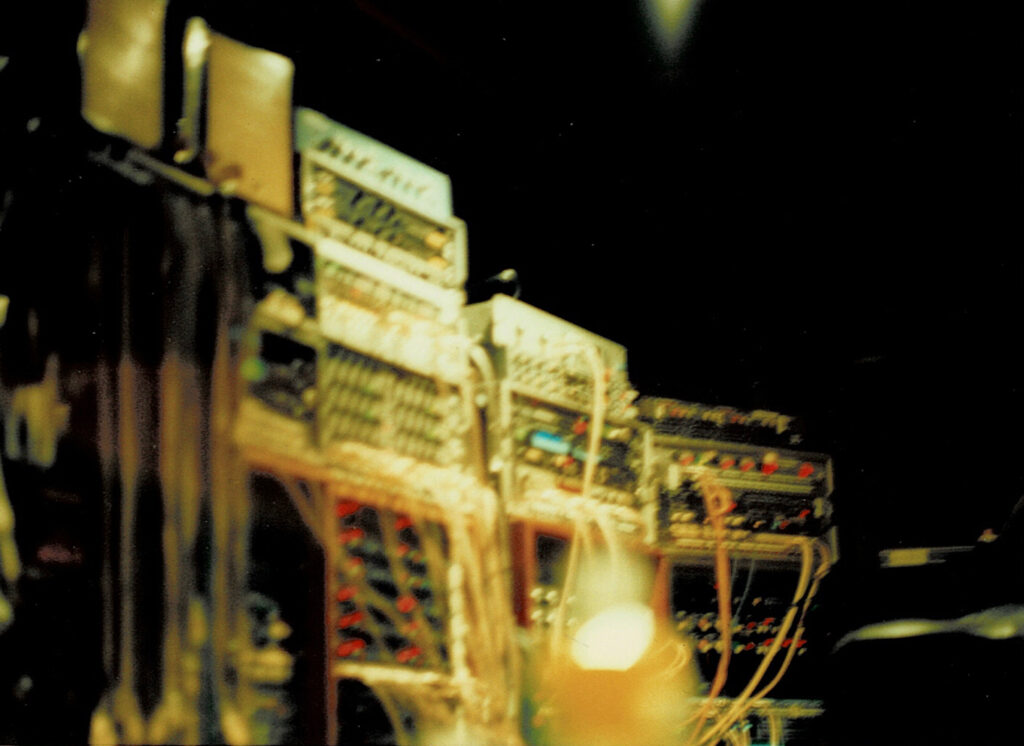
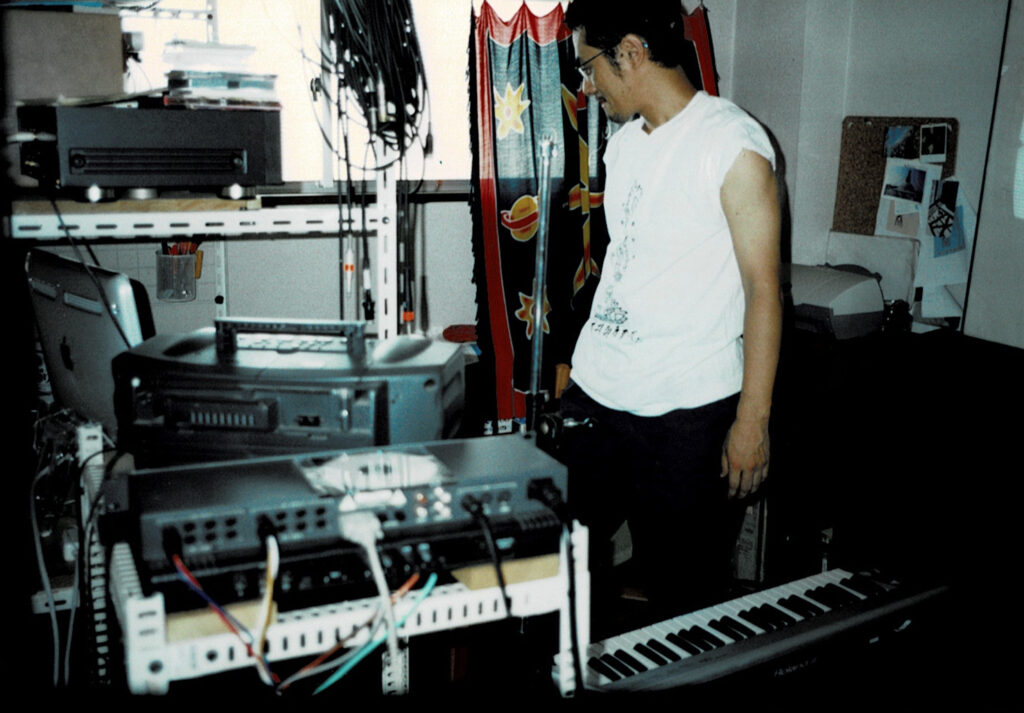
My starting point is guitar playing, influenced by Jimi Hendrix, Jimmy Page, Bert Jansch, and others. The guitar and percussion are live performances. Everything else is MIDI from Cubase 5 controlling Moog and Prophet 5. The kalimba phrases are sampled, sliced in Recycle, and controlled via MIDI. Like the Ketsa in Neo Geo. I also mix in reverse-rotation sampling, influenced by the Beatles.
I’m guessing this album was recorded in Tokyo, which is a very urban landscape and quite different from the tropical landscapes imagined in this music. Can you talk about some of the places that have inspired you?
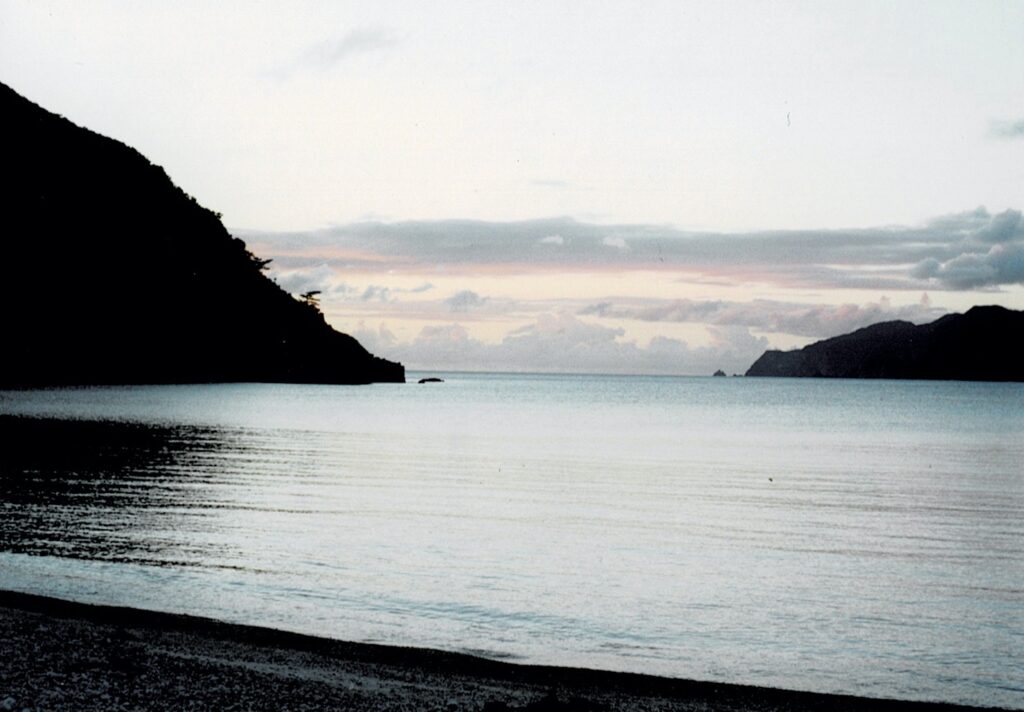
Staying on Amami Ōshima and Okinawa. And then there’s the influence of “GARO,” a Japanese subculture manga magazine.
What albums were you listening to at the time of this recording? Any guitarists, instrumentalists, or other artists that were particularly inspiring to you?
The artists mentioned earlier are SUBA, Ryuichi Sakamoto, Jeff Beck, Ry Cooder, and Bert Jansch. The albums are SUBA Tanto Tempo, Radiohead Kid A, and Nelson Angelo E Joyce Um gosto de fruta.
What was the initial response to this album? I understand that it’s since become something of an underground favorite, and now has renewed interest with the Forest Jams reissue. How does it feel to listen to this music again after so many years?
When I released it, there was absolutely no reaction! Dead calm. But since it was an important work for me, I was just glad I could release it. I never imagined this piece would be rediscovered, so I’m incredibly happy!
Listening back, it was really good, and it contained my essential essence.
My interest now is in old blues, so I’m thinking it might be interesting to mix that with electro.
The term “Walearic” has since been coined by Shotaro Matsumoto of Coconut Disk Ekoda. What do you think of this term, and Japan’s love for tropical landscapes? Nippon’s “Paradise Series” must have had some relation to this “Walearic” concept.
I don’t know Mr. Shōtarō Matsumoto personally. But I believe Japan’s exotic charm lies in its diverse cultural influences, natural environment, and cultural appeal.
MEITEI’s latest album AGATE / 瑪瑙 is available now for pre-order via In Sheep’s Clothing Records. Daisuke Fujita aka MEITEI is a Hiroshima-born, Kyoto-based artist and composer who […]
Brazilian bossa guitar meets lush electronic textures and modular synthesizers on Aquaticos, out now on Music from Memory! Fabiano Do Nascimento and E Ruscha V aka Secret Circuit […]
Join us on Thursday, March 19th for a Record Bizzy listening party featuring Latin American underground music from ZZK Records! Last Halloween, we attended an event in the […]

Olive Ardizoni and Michael Flanagan discuss their new Ghostly International album Hinterlands, the sounds and ideas behind it and an upcoming performance at the Geoponika Greenhouse. Green-House emerged […]
Voices from around the world read Banabila’s words over quietly shifting electronics on Through Global Frequency, released by Glasgow’s 12th Isle. Michel Banabila’s shockingly beautiful Through Global Frequency […]
Anthology Of Persian Experimental Music is now available on Bandcamp as a pay-what-you-want download. When Italian curator Raffaele Pezzella began researching experimental music scenes for his label Unexplained Sounds Group, […]