



From ‘Dark Magus’ and The Dead to Water Damage and Musique Concrete, the archive hosts an astounding mass of live recordings. This year has been brutal for the […]


Long before there was a sound system humming beneath the bare brick of the Arts District, before In Sheep’s Clothing HiFi was even an idea pressing against the walls of my mind, there was another experiment in belonging. It stood on Fairfax Boulevard, West Hollywood adjacent, on the same plot where Largo once tuned its evenings to laughter and strange grace. Out front, the word Community was laid in tile, not as a declaration but a reminder, a signal to anyone crossing that threshold: what you were entering wasn’t just a venue, but a field of relation. That word set the terms for everything that followed.
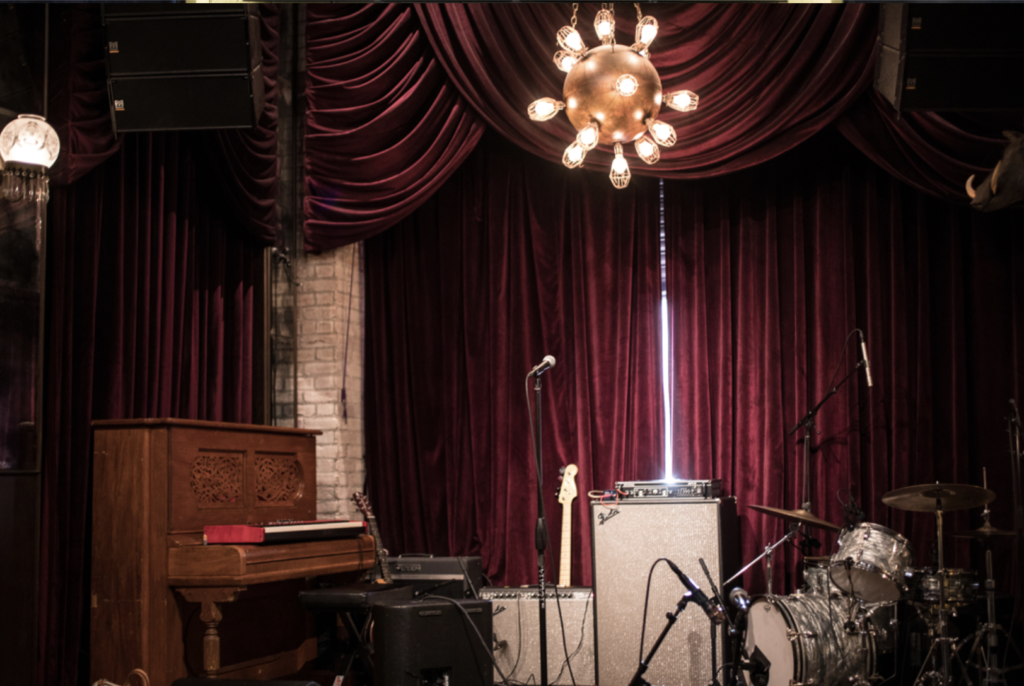
The paradox was the name. Or rather, the refusal of one. A friend’s friend once told her who relayed to me, “If you don’t name it, people will have to describe what it feels like to be there. Then it has all the names.” No Name. A title that swallowed all titles, a kind of zen arithmetic of absence. When it opened in 2013, the place filled in the gaps of LA, then a city briefly unsure of its pulse. It became a restaurant, a bar, a small cinema and a stage. But more than that, it was the conversation between them, the invisible frequencies connecting one table’s laughter to another’s late night piano chord.
One night in 2015, that signal reached back through the decades of musical history and rewired my own circuitry. That was the night I met Bob Weir.
Bernie Cahill is a friend, ally, and patient orchestrator of musicians and he had called ahead for a table. He’d just brought Dead and Co. into the fold at his mgmt company, and now he was bringing their spirit to dinner. I set aside the corner booth with the secret box, a lockbox in the table meant for a communal book where each guest left a trace, an inscription, a word to fold back into the collective memory of the room. That’s where I would seat Bernie and Bob.
By the time I arrived, they were already there, leaning into conversation, faces lit with the easy warmth of shared recognition. The kind that folds ten minutes into ten years. I was about to cross over to say hello when Tyler, our GM, always scanning, attuned, intercepted me mid-stride, electric with interruption. “You have to go upstairs,” he said.
The upstairs had a circular table shaped like a vinyl record, I looked up, half-smiling, ready to wave it off. Epic dates happened here all the time. But Tyler kept his eyes locked on mine, urgency in the look. “Just go upstairs. For a second.”
I went. At the top of the stairs, the air seemed denser, almost charged. The first form resolved itself into Ringo… sunglasses, jacket perfectly tailored, the iconic cool of a man who carried rhythm in his bones. Then Dave Grohl. Then Joe Walsh. Then McCartney, radiant in that unassuming way the truly legendary have. They were seated in a circle of couples, each with a modest plate of vegan food before them, as though the universe had decided to tuck one last rehearsal dinner for history into my upstairs room.
I ducked into the hallway by the soundboard, to collect my thoughts then re-entered where I introduced myself lightly, an emissary from below, offering a host’s small pleasantries. Their kindness was unforced. I withdrew, unwilling to break whatever molecular balance was spinning between them.
When I reached the bottom of the stairs, Tyler was there waiting, speechless except for that one, repeated syllable: “Dude.” Laughter vented the shock. He told me Grohl had noticed Bob Weir while waiting in the bathroom queue and whispered the recognition like a child hearing a secret. He then told me to look at Romanelli’s table, an area of No Name that was designed by another friend Darren Romanelli. At that table sat Taylor Swift and Hozier with some of their friends and while that could have been interesting on any other night, it didn’t really even register on this one. I told Tyler I was going to go say hi to Bernie and meet Bob.
When I reached their table, Bernie rose with that familiar smile, the kind that could disarm a boardroom or a barroom equally. He clasped my shoulder, turned to Bob, and said my name like a key unlocking an introduction. Bob Weir extended his hand.. calm, understated, the weight of decades folded gently into the gesture. I joined them, and a beverage appeared before me as naturally as breath.
I’ve never claimed to be a Deadhead. Not by the usual metrics, not the show counts or the live tapes stashed in glove boxes, not the tattoo inked to the ankle. But what that music meant to the people I love, my friends who built worlds around its improvisations, its endless pulse of generosity, that had always registered somewhere in the deeper parts of me. Sitting across from Bob Weir, that resonance came up through the floorboards. The moment felt less like meeting a man and more like being briefly tuned to a frequency that had been playing all along, low and steady, underneath the noise of living.
I can’t recall the particulars of our talk. What I do remember is the timing and restless awareness that something astonishing was unfolding just one floor above us, and the knowledge that its gravitational pull would find us soon enough. When I finally leaned toward Bernie and murmured what I’d seen upstairs, he turned to me as though we’d shared one continuous consciousness: We’ve got to bring Bob up.
Down became up, inevitably. I excused myself and climbed the familiar stairs, each step creaking like a prelude. The upstairs glow was intact, all vegan plates nearly finished, the circle of faces still half lit by laughter. For reasons I couldn’t entirely explain, my trajectory led me straight to McCartney. Maybe it was instinct, maybe magnetism. I crouched beside him and said quietly, “I don’t mean to interrupt, but Bob Weir is downstairs, having dinner.” Time paused. Then, as though a signal had passed through him, Paul’s expression brightened into something childlike. “Well, bring him up!” he said. His reaction flipped some unseen switch. I turned to the stairs, already in motion, already knowing how the scene would play. From below, I spotted Tyler by the table with Bernie and Bob, his eyes locking with mine in instant comprehension. A nod, a wave, the simplest of signals: It’s on.
Within moments, they were ascending. Tyler reached the top first, tapped McCartney on the shoulder. Paul spun, saw Bob, and laughter burst through the room like feedback from the cosmos. “Bob ol’ boy, what the hell are you doing here?” he said, and with that line the upstairs dissolved into something that wasn’t dinner or chance or even memory, it was music again.
Every legend at that table became a fan all over. Grohl, Walsh, Ringo, each leaning in, their tones softening into that reverent disbelief reserved for people who once rewired their DNA. Bob, usually the one surrounded by tribute, looked taken aback by the openness of their awe. Artists who’d lived on the receiving end of worship now offering it without irony. There was something democratizing, even holy, about it as if all those songs, all that history, were momentarily suspended between them, asking only to be acknowledged.
That was No Name at its purest form. A room that bent hierarchy until it vanished, that dissolved the false elevation between creatives. Its walls seemed to absorb ego and return only presence. It was simple recognition: here you are, and so am I.
Eventually, Bob and Bernie drifted back downstairs. They reclaimed their table and inscribed themselves, literally, into the place. Beneath the flicker of the votive light, Bob lifted the cover of the locked box and left his mark in the communal book:
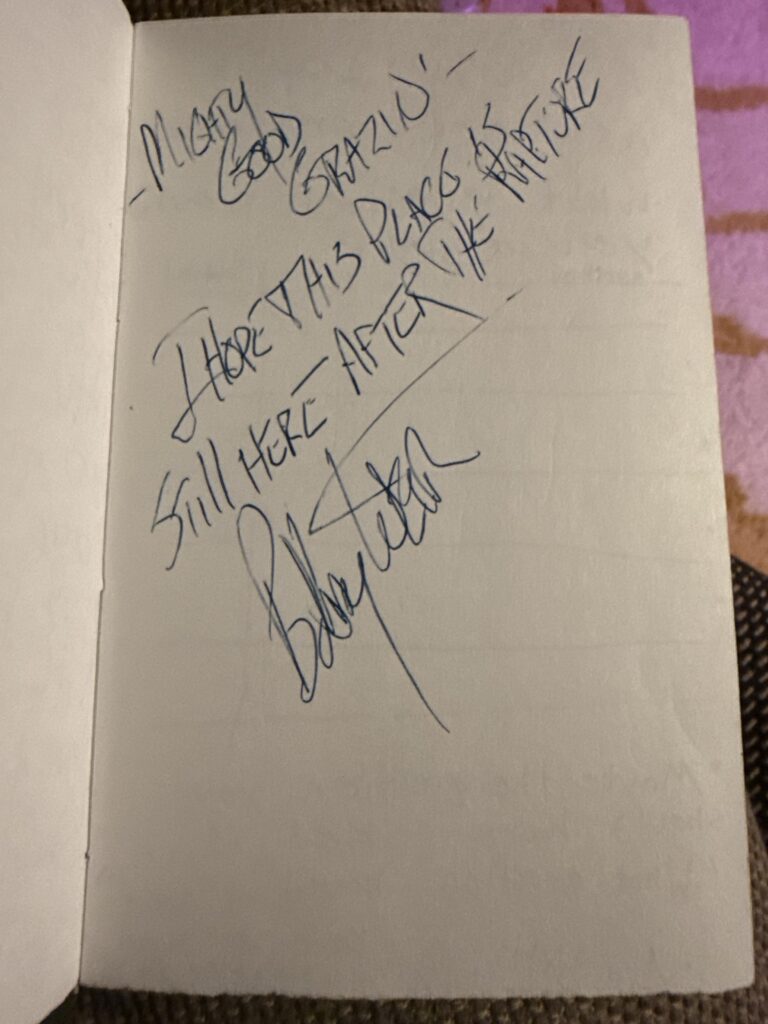
“Mighty good grazin’ — I hope this place is still here after the Rapture.”
Bobby Weir
That was the only conversation we ever shared, though our paths had crossed invisibly in rooms charged with the same frequencies both before and after that night. A year later, he returned to play songs from Blue Mountain, right there on that same stage. The feed from his guitar threading into the rafters where ghosts of those earlier nights still hung. I was on tour then, orbiting elsewhere. I sometimes think that’s how these moments survive, not in the replay but in their after sound, the lingering note that vibrates long after the music stops. No Name kept that kind of resonance. It held memory the way an instrument holds tone. And when I think of Bob now, with both a guitar and a pen in hand, somewhere between this world and the next, I can almost hear it.. the low hum of the room itself, still tuning, still waiting for the next song.
From ‘Dark Magus’ and The Dead to Water Damage and Musique Concrete, the archive hosts an astounding mass of live recordings. This year has been brutal for the […]
John Oswald’s deconstructionist ‘Plunderphonics’ collage approach meets the Grateful Dead. In the early 1990s, the Canadian sound artist John Oswald was granted full access to the Grateful Dead’s […]

Legendary Klipsch, McIntosh, Altec, Sansui equipment from the Grateful Dead go up for auction this Thursday. On Thursday, Sotheby’s will open bidding on a breathtakingly deep auction of […]
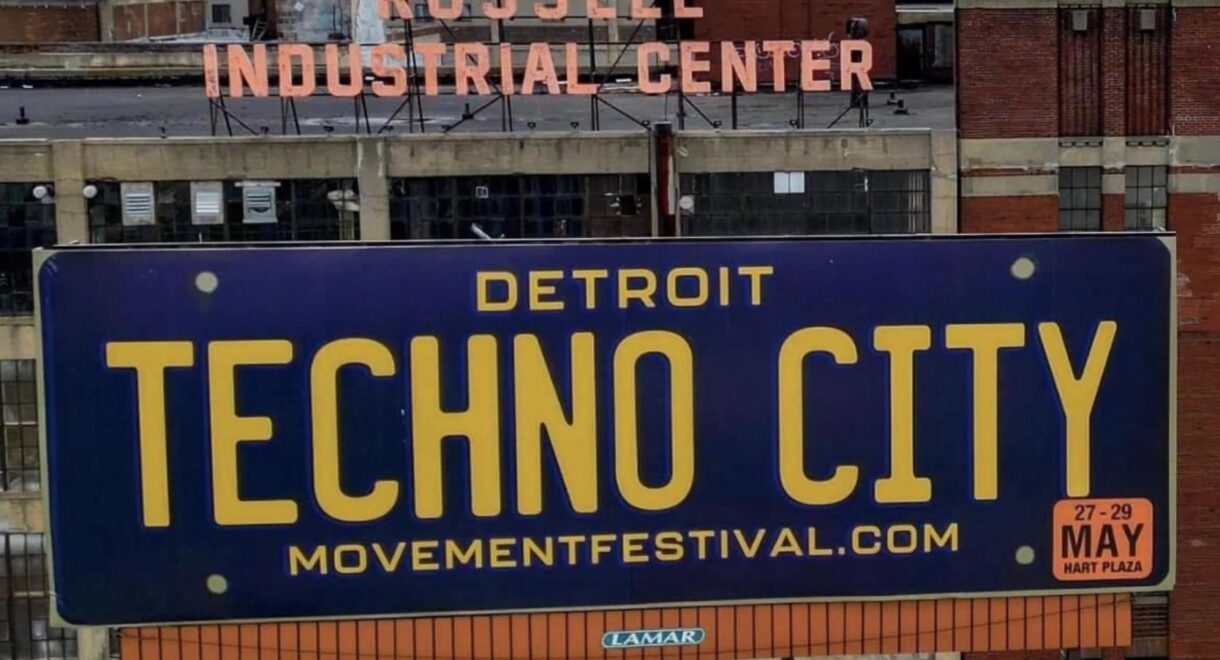
Join us April 3rd for a celebration of Detroit techno at Agora Records featuring listening sessions of classic albums along with a DJ set from Detroit legend Santiago […]
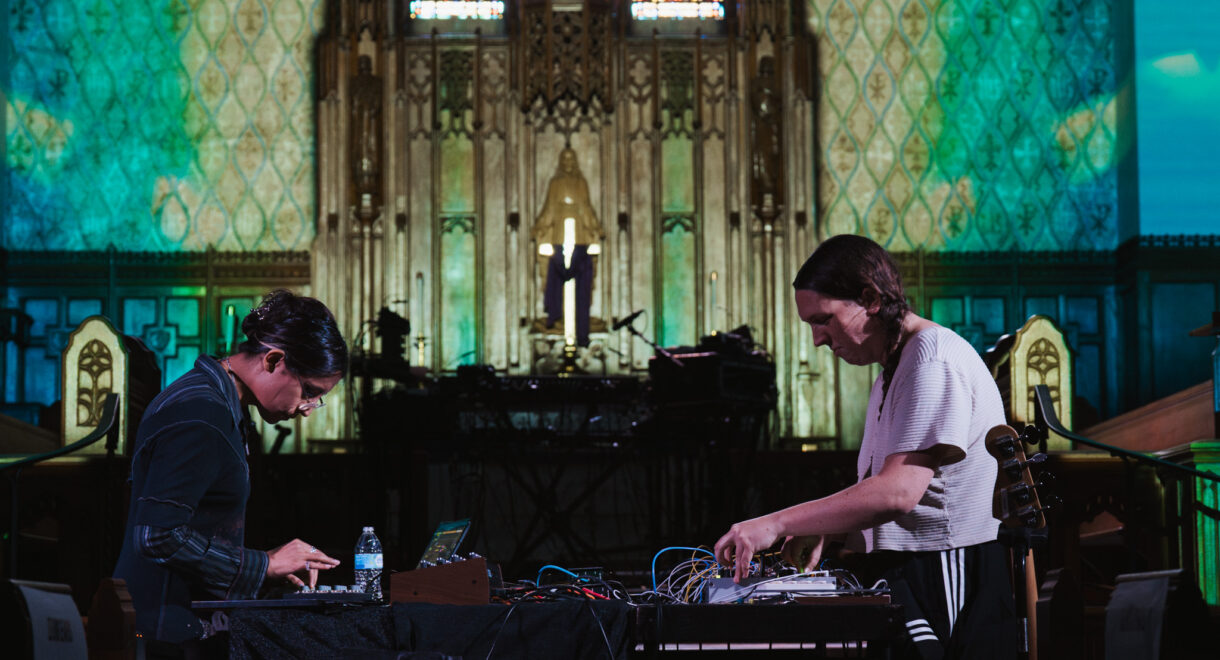
A guide to the conversations shaping this year’s festival, from John Zorn’s far-reaching influence to the future of music writing, independent labels, and the ways listening itself gets […]

MEITEI’s latest album AGATE / 瑪瑙 is available now for pre-order via In Sheep’s Clothing Records. Daisuke Fujita aka MEITEI is a Hiroshima-born, Kyoto-based artist and composer who […]